
1.Why Do Headlights Actually Fail? (The Real Breakdown)
Nasty Terminal Corrosion:
In high-humidity areas, moisture sneaks right into the wiring harness connectors. Over time, the copper pins rust and oxidize. This creates a massive voltage drop. The electricity simply can't push through, leading to flickering lights or a completely dead bulb even if the bulb itself is brand new.
Tired Relays & BCM Glitches:
The headlight relay is basically the heavy-duty switch doing the dirty work. Click after click, those internal contacts get charred and pitted. When that happens, power stops routing to your low or high beams. On newer cars, a glitch in the BCM (Body Control Module) can also falsely trigger a safety shut-off, killing the power on purpose.
Leaky Housing (Moisture Ingress):
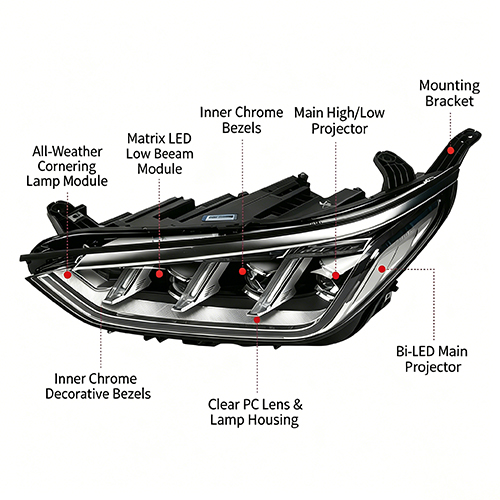
If the perimeter seal fails or there’s even a hairline crack in the polycarbonate lens, moisture gets sucked inside. This creates a tiny, destructive greenhouse. That trapped humidity will short-circuit internal wiring, thermal-shock the bulb, and fry expensive electronic drivers in no time.You can visit our [Car Light Products] to restore your vehicle's look and safety.
2. LED vs. HID (Xenon): Which One Wins for the Aftermarket?
If you're stocking inventory or upgrading vehicles, you need to know how these two stack up where it actually matters.
Metric 1: Instant Brightness (No Waiting Around)
LED: Hits 100% full brightness in a fraction of a millisecond. The exact second you flip the switch, it’s blindingly bright. This instant activation is a game-changer for high-beam flashing and plays perfectly with modern driver-assistance (ADAS) systems.
HID: Relies on a ballast to ignite Xenon gas with a high-voltage arc. Because of that, HIDs need a 5 to 15-second "warm-up" period to heat up the gas and reach peak lumens. If you flash your high beams with HIDs, they won't look fully bright right away.
Metric 2: Lifespan & Thermal Management
LED: Extremely efficient (100+lm/W). Since it’s solid-state electronics, a quality LED bulb easily lasts 20,000 to 50,000+ hours. They don't emit much heat forward, but they get scorching hot at the base, meaning they need heavy-duty aluminum heat sinks or active mini-fans to keep the junction cool.
HID: Usually caps out around 10,000 to 25,000 hours. The internal metal halide salts and electrodes naturally degrade over time as they get eaten up by that intense electrical arc.
Metric 3: Beam Pattern & Blinding Oncoming Traffic
LED: Emits a highly directional, laser-focused beam. Because it’s so focused, LEDs must be paired with precisely engineered projector lenses or reflector optics. If you throw a cheap LED bulb into a housing built for halogen, it will scatter light everywhere and blind oncoming drivers.
HID: Fires light in a full $360^{\circ}$ circle. HIDs offer incredible, sweeping long-distance visibility, but they absolutely require specialized projector housings with a sharp cutoff line to manage that massive output safely.
Summary: Which Should You Actually Choose?
Go with LEDs if: You want a modern, set-it-and-forget-it headlight. They last forever, draw very little power, and turn on instantly. They are hands-down the best fit for New Energy Vehicles (NEVs) and modern fleets.
Go with HIDs if: You or your clients are driving long-haul routes on pitch-black rural highways. Nothing beats the sweeping depth-of-field and wide-angle peripheral light that a good HID projector setup can throw down the road.