
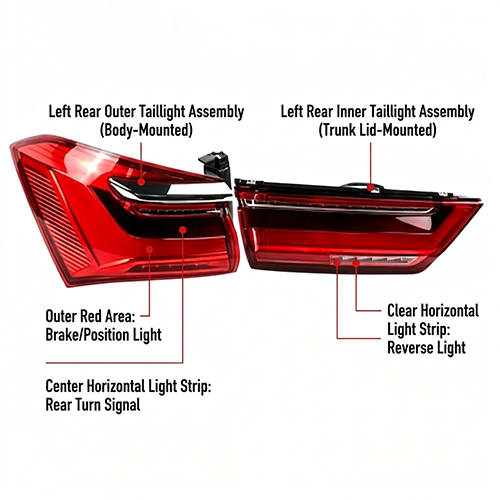
When you're sourcing rear light assemblies for the aftermarket, you quickly realize that a premium tail lamp is never just a simple red lens with a bulb behind it. It’s actually a highly regulated, engineered setup combining five distinct types of illumination—each with its own specific lumen output, color requirements, and lens optics.
If you are dealing with wholesale buyers, fleet managers, or repair shops, here is a straight-to-the-point breakdown of the five core lighting functions built into modern rear lamp assemblies:
1. Tail Lights / Running Lights (The Baseline Ambient Presence)
What it looks like: Low-intensity Red.
The technical side: This is the continuous, lower-lumen background light. It kicks on the second you flip your position lamps or headlights on. The engineering trick here is keeping it bright enough to be seen from a distance but dim enough so it doesn't blind the driver behind you.
What it’s for: It outlines the car's width and presence in the dark or inside tunnels. On newer New Energy Vehicles (NEVs), factories love making these into sleek, continuous LED light bars or those trendy 3D floating light pipes you see everywhere now.
2. Brake / Stop Lights (The Instant High-Lumen Warning)
What it looks like: High-intensity Deep Red.
The technical side: These need to be several times brighter than your standard running lights. High-quality LED tail lamps are a massive upgrade over old halogens because they hit 100% full brightness in under 1 millisecond.
What it’s for: To instantly scream at the driver behind you that you’re slamming on the brakes. Working together with the third brake light (CHMSL), this rapid blast of deep red light cuts down trailing driver reaction times and actively stops rear-end pileups.
3. Turn Signal Lights / Indicators (The High-Penetration Dynamic Sign)
What it looks like: Amber / Selective Yellow (though North America still allows red on some models).
The technical side: These are engineered with intense color saturation so they can cut through heavy rain or fog. For modern electric cars and premium aftermarket upgrades (like recent BYD or MG models), the old-school blinking bulb is out—everyone wants those high-end Sequential Matrix LED Sweeping Lights that animate across the housing.
What it’s for: Plain and simple—telling everyone behind you exactly where you're turning or changing lanes, or flashing both sides as a hazard warning.
4. Reverse Lights / Back-up Lamps (The Only White Light in the Back)
What it looks like: Crisp Xenon White.
The technical side: This is the only pure white light source on the back of the car. Since almost every modern vehicle relies on a backup camera now, a good reverse light needs specialized wide-angle optics to throw light wide and clean up any low-light grain on the driver's dashboard screen.
What it’s for: It does two jobs at once: it acts like a flashlight so the driver can see blind spots while backing up at night, and it acts as a clear warning to pedestrians that the car is actively rolling backward.
5. Rear Fog Lights (The Bad-Weather Lifesaver)
What it looks like: Ultra-bright Sharp Red.
The technical side: This is the most piercing red light on the back of the vehicle, designed specifically to slice through airborne particles. It runs on a completely separate switch, and honestly, you're only supposed to turn it on when visibility drops to near zero.
What it’s for: You use this in dense fog, blinding rain, or nasty dust storms. It gives high-speed traffic or long-haul trucks behind you a sharp, bright point of reference so they don't rear-end you on the highway.